Experimental investigation of non-ideal compressible flows of organic vapors for ORC applications
[vc_separator type=’transparent’ position=’left’ color=” thickness=” up=’15’ down=”]
Advisor: Spinelli Andrea
Co-Advisors: Giorgia Cammi, Camilla Conti, Simone Gallarini, Alberto Guardone
[vc_separator type=’transparent’ position=’left’ color=” thickness=” up=’15’ down=”]
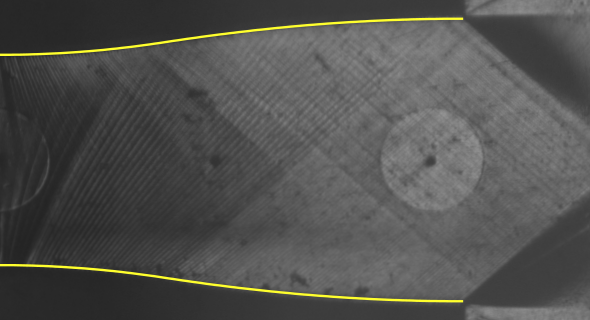
The TROVA (Test Rig for Organic VApors) is a facility built at CREA Lab (Politecnico di Milano) implementing a batch organic Rankine cycle. The turbine is replaced by a test section, where fluid dynamics measurements are performed. Within a high-pressure reservoir an organic fluid (currently a siloxane) is evaporated up to non-ideal saturated, superheated or supercritical thermodynamic conditions. The vapor is then discharged through a planar, converging-diverging nozzle, the simplest test section which realizes an expansion process comparable to the one occurring within ORC turbine blade channels. The vapor is then condensed and pumped back to the high-pressure reservoir.  The flow field within the nozzle is characterized by pressure and temperature measurements and by schlieren visualizations, aiming at investigating the different behavior with respect to the ideal gas one. In such a way, also the accuracy of the CFD tools (embedding non-ideal thermodynamic models) employed for the design/analysis of ORC components (and for diverse non-ideal applications) can be verified. Besides nozzle flows, are also of interest the study of non-ideal behavior of oblique and normal shock waves, which are obtained by inserting aerodynamic or bluff bodies within the supersonic flow downstream the TROVA test section.
[vc_separator type=’transparent’ position=’left’ color=” thickness=” up=’15’ down=”]
The thesis consists in performing temperature, pressure and velocity measurements and schlieren visualizations in converging diverging nozzles, in the characterization of the fluid dynamics (shock waves) around aerodynamic bodies and in the comparison of experimental values with those obtained by CFD simulations.
More info: andrea.spinelli@polimi.it
[vc_separator type=’transparent’ position=’left’ color=” thickness=” up=’15’ down=”]
[button size=’medium’ style=” text=’APPLY’ icon=” icon_color=” link=’mailto:andrea.spinelli@polimi.it’ target=’_blank’ color=’#ffffff’ hover_color=’#ffffff’ border_color=” hover_border_color=” background_color=’#dd6719′ hover_background_color=’#f28033′ font_style=’italic’ font_weight=’600′ text_align=’center’ margin=’15’]